How Much Does an AI Receptionist Cost? (2026 Pricing Guide)
An AI receptionist costs from EUR 297/mo, far less than a full-time hire. Here is what drives the price and how to work out your own number.


An AI receptionist costs from EUR 297 per month with Automis Voice AI, and a higher tier sits at EUR 497 per month for busier phone lines. That is a flat monthly fee for a voice agent that answers every call 24/7, qualifies the caller, books the appointment, and syncs it to your CRM. For most appointment-based businesses that is a fraction of a full-time receptionist salary, and the real question is not "how much does an AI receptionist cost" but "how much are the calls you already miss costing you." This guide breaks down the price, what actually drives it, and how it stacks up against a human hire and a traditional answering service.
How much does an AI receptionist cost per month?
An AI receptionist from Automis starts at EUR 297 per month on the Starter plan, with a higher tier at EUR 497 per month for practices with heavier call volume. Both are flat, predictable monthly fees. You are not billed per minute and you are not billed per call, so a busy month does not turn into a bigger invoice.
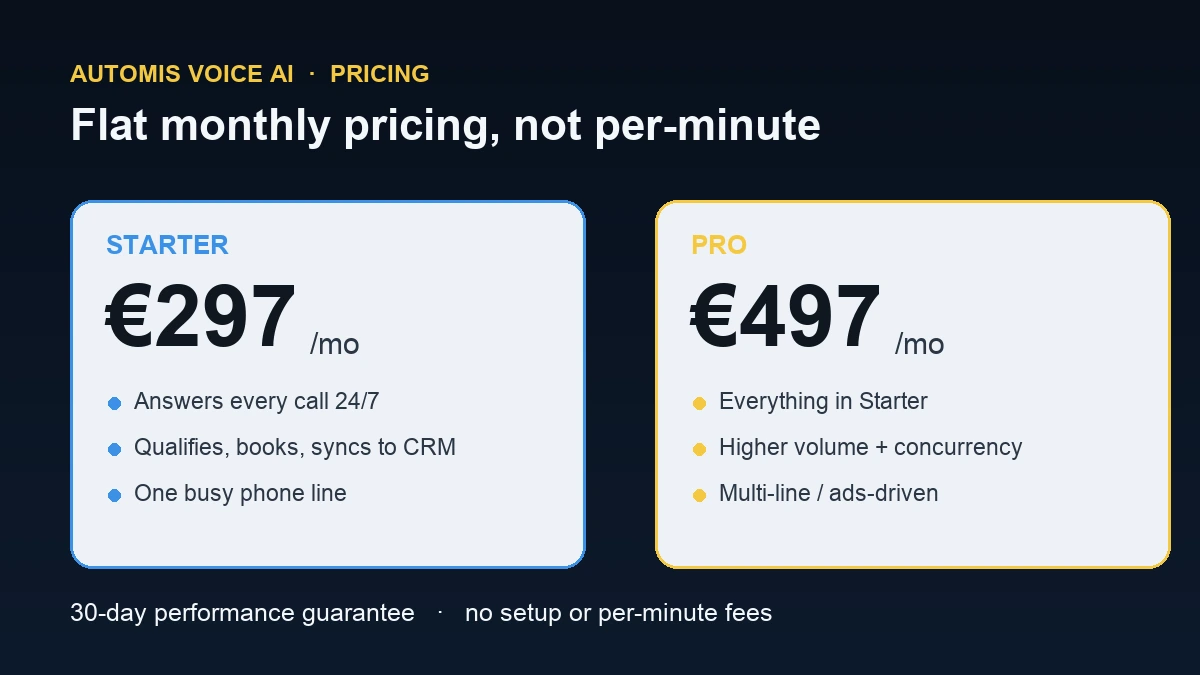 AI receptionist pricing tiers: Automis Starter at EUR 297 per month and the higher tier at EUR 497 per month, both flat monthly fees with no per-minute billing
Why a flat monthly fee beats per-minute billing
The reason a flat fee matters is simple: your phone traffic is lumpy. A single ad, a local event, or a seasonal spike can double your inbound calls in a week. With per-minute pricing, that surge becomes a cost you cannot forecast. With a flat plan, the same surge is just more appointments booked at the same price. Every plan also carries a 30-day performance guarantee, which means you can watch it book real appointments before you commit for the long term.
Rule: if a vendor bills you per minute, they profit when your callers wait on hold. Flat pricing puts you both on the same side.
What EUR 297 to 497 per month actually buys
At this price you are not renting a voicemail with a friendlier voice. You are getting a voice agent that greets the caller, answers routine questions, checks a live calendar, books the correct appointment type, writes it back to your CRM, and follows up on the calls that slip through. Put next to a single part-time wage, it is a rounding error, and it works every hour of every day rather than a shift.
What drives the price of an AI receptionist?
The price is driven by call volume and by how much work the agent does on each call, not by hidden usage meters. On the two Automis tiers, the difference between EUR 297 and EUR 497 per month comes down to the scale of the phone line and the depth of the workflow behind it.
Call volume and concurrency
A single-line clinic that takes a few dozen calls a day sits comfortably on the Starter plan. A multi-line practice, or a business running paid ads that spike inbound calls, needs the headroom of the higher tier so that two, three, or more callers can be handled at the exact same moment without a busy signal. Concurrency is the quiet cost driver: a human receptionist can only hold one line at a time, and an AI receptionist that can hold many is worth more precisely when you are busiest.
Depth of the workflow
A basic "answer and take a message" bot is cheap because it does almost nothing. An AI voice receptionist that qualifies the caller, checks a live calendar, books the correct appointment type, and writes it back to your CRM is doing the job you would otherwise pay a person to do. The Automis Voice AI receptionist sits at the second end of that range: it is built to complete the booking, not just log that a call happened.
Integrations and the recovery layer
Two capabilities quietly separate a real receptionist from a novelty. The first is CRM and calendar integration, so a booked call becomes a real, synced appointment. The second is missed-call recovery: when a call does slip through, the system follows up instead of letting the lead evaporate. Both are included rather than sold as costly add-ons, which is why the headline price stays flat.
Rule: you are not paying for minutes of talk time. You are paying for booked appointments that show up on your calendar.
Is an AI receptionist cheaper than hiring a human receptionist?
Yes, and the gap is larger than the salary line alone suggests. A full-time receptionist in the US costs roughly USD 35,000 to 45,000 per year in base pay, an illustrative range drawn from public salary sources such as the US Bureau of Labor Statistics Occupational Employment and Wage Statistics data and Glassdoor self-reported salaries; the European equivalent is broadly comparable and varies by country. That figure is only the starting point.
On top of salary you carry payroll taxes, holiday pay, sick days, training, turnover when they leave, and the plain fact that one person covers roughly eight hours on weekdays. Nights, weekends, lunch breaks, and the second call that comes in while they are already on the phone are all uncovered. An AI receptionist at EUR 297 to 497 per month covers all of those hours, answers concurrent calls, and never quits. Even at the top tier that is well under one fifth of a single salary, for coverage a single hire cannot physically provide.
This is not an argument to fire your front desk. A good AI receptionist frees your team from the phone so they can look after the people actually in the room, and it catches the calls your team was never going to reach in the first place.
AI receptionist vs human receptionist vs answering service: cost and value
An AI receptionist wins on both predictable cost and round-the-clock coverage, while a human wins on genuine human warmth and an answering service sits awkwardly in the middle. The table below lays out the trade-off. Salary and answering-service figures are illustrative public ranges, attributed and clearly marked, not precise quotes.
| What you compare | AI receptionist (Automis Voice AI) | Full-time human receptionist | Traditional answering service |
|---|---|---|---|
| Typical cost | Flat EUR 297 to 497/mo | Roughly USD 35,000 to 45,000/yr salary, plus taxes and benefits (illustrative, per BLS / Glassdoor) | Usually per minute, per call, or a monthly retainer (illustrative; varies widely by vendor) |
| Cost predictability | High: flat fee, no per-minute meter | Medium: salary is fixed but cover, overtime, and turnover add up | Low: per-minute billing spikes with your busy months |
| Hours covered | 24/7, including nights, weekends, holidays | About 8 hours on weekdays, one line at a time | Often 24/7, but quality and scope vary |
| Concurrent calls | Many at once, no busy signal | One at a time | Depends on staffing on their end |
| Books into your calendar and CRM | Yes, native and automatic | Yes, if trained and diligent | Rarely: usually just takes a message |
| Qualifies the lead | Yes, consistent every time | Yes, but variable by person and by day | Limited: scripted message-taking |
| Recovers missed calls | Yes, built in | Only if someone remembers to call back | Not typically |
The pattern is clear. A human gives you warmth and judgement but limited hours and unpredictable total cost. A classic answering service gives you a voice but usually stops at taking a message, and its per-minute model makes your busiest months your most expensive. An AI voice receptionist gives you predictable pricing, full coverage, and, crucially, a completed booking rather than a sticky note. If your growth plan leans on AI automations elsewhere in the business, a receptionist that writes clean data straight into the CRM is the front door that feeds all of them.
Rule: an answering service takes a message. A receptionist, human or AI, takes the booking. Only pay for the second one.
What is the real cost of the calls you already miss?
The most expensive receptionist is the one you do not have, because every unanswered call is revenue walking out the door. Between 30 and 50 percent of calls to local businesses go to voicemail. In an appointment-based business, a voicemail is rarely a callback. It is a prospect who dials the next clinic, the next salon, or the next firm on the list.
A worked example on real numbers
Put a number on it. Say your average new booking is worth EUR 250 in first visit plus early repeat value, and you miss ten calls a week. If even three of those ten would have booked, that is EUR 750 a week, or roughly EUR 3,000 a month, in bookings that never happened. Against a EUR 297 plan, the receptionist has to recover barely more than one of those calls a week to pay for itself, and everything above that line is margin you were previously donating to the competitor who did pick up.
That loss is invisible on your profit and loss statement because it never became an invoice, which is exactly why it goes unmanaged. An AI receptionist priced at a flat few hundred euros a month exists to convert that silent leakage back into booked appointments.
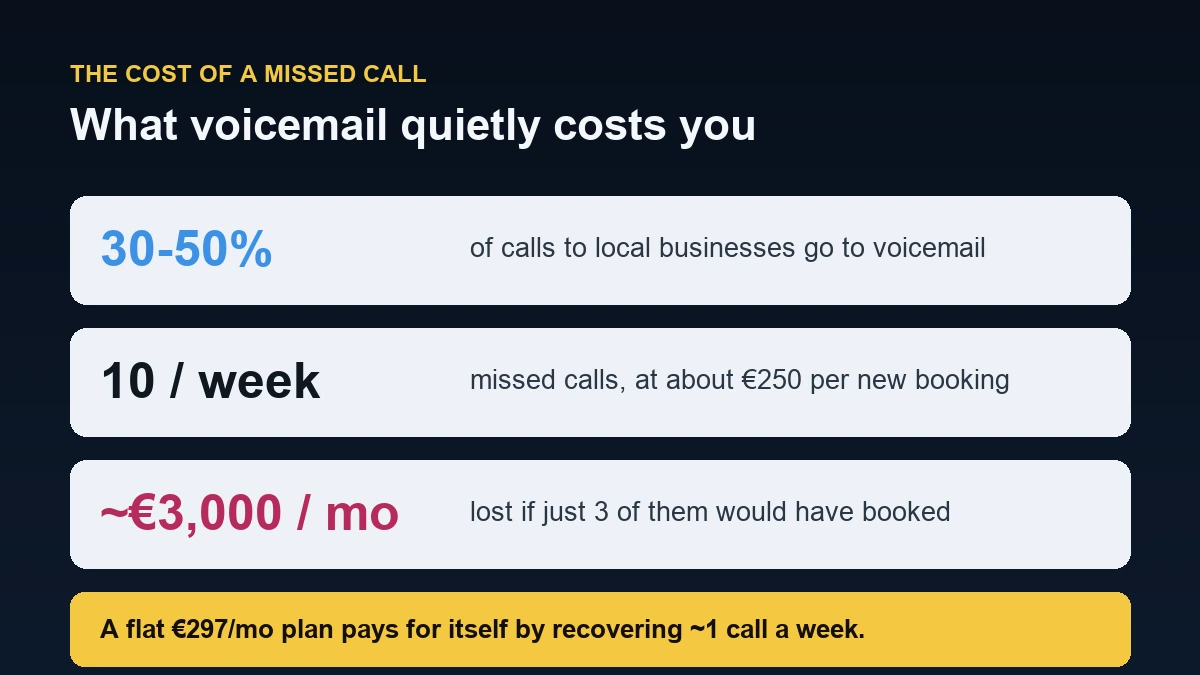 Missed-call revenue calculator showing weekly missed calls turned into an estimated monthly revenue figure lost to voicemail
Get your own figure, not a rule of thumb
If you want your own number rather than a rule of thumb, run it through the free Automis missed-call revenue calculator to estimate the revenue slipping through your phone line, and the no-show cost calculator to see what empty slots are costing you on top of that. Both take a couple of minutes and give you a concrete number to weigh against the monthly plan, and you can browse the rest of the free Automis calculators and tools while you are there.
How does the cost play out in practice?
For a real deployment, look at Clinica Santa Maria, a dental clinic in Lisbon running the Automis AI voice receptionist on its live phone line. The clinic uses the agent to answer calls, handle patient questions, and book appointments across voice and messaging, so the front desk is not tied to the phone while patients are standing at the counter. Setup is quick rather than a drawn-out onboarding, so the clinic was capturing calls it would otherwise have missed almost from day one.
The return is measured in captured calls, not features
The value there is not an abstract line on a pricing page. It is a busy practice where calls that used to hit voicemail at lunch, after hours, or during a rush now turn into booked appointments, on a flat monthly fee rather than a second salary. A dental chair sitting empty because nobody could pick up the phone is a direct loss, and a receptionist that never stops answering is how you stop paying for those gaps.
Who feels the difference most
The businesses that feel it most are the ones with lumpy phone traffic and high-value appointments: dental and medical clinics, aesthetic and beauty practices, professional-services firms, and real estate teams. In every case the shape of the return is the same. You are buying back the calls that were quietly leaking away, which is exactly the calculation most appointment-based businesses are running when they weigh the cost of an AI receptionist.
Is an AI receptionist worth the cost for a small business?
For any business that lives on booked appointments, the answer is almost always yes, because the math turns on missed calls, not on the sticker price. If a single recovered booking a week already covers a large share of the monthly plan, the plan pays for itself quickly and everything above that line is upside.
The honest test is not "can I afford EUR 297 a month." It is "how many calls am I losing, and what is each one worth." Run the two calculators above, compare the loss to the flat plan, and the decision usually makes itself. For the wider picture of how these agents work day to day, the guide to Voice AI receptionists walks through the mechanics in more depth. If you want a straight answer for your specific call volume and setup, talk to the Automis team and we will size it against your real numbers rather than a generic range.
Frequently Asked Questions
How much does an AI receptionist cost per month?
An AI voice receptionist from Automis starts at EUR 297/mo on the Starter plan, with a higher tier at EUR 497/mo for busier phone lines. Both are flat monthly fees, so your cost does not spike when call volume does.
Is an AI receptionist cheaper than hiring a receptionist?
Yes, and by a wide margin. A full-time receptionist runs roughly USD 35,000 to 45,000 per year in salary alone (per public salary sources such as the US Bureau of Labor Statistics and Glassdoor), before payroll taxes, benefits, and cover for sick days. An AI receptionist at EUR 297 to 497/mo answers every call 24/7 for a fraction of that.
Are there setup or per-minute fees?
Automis plans are flat monthly pricing, not per-minute billing, so a busy month will not surprise you with a bigger invoice. Traditional answering services often bill per minute or per call, which makes their real cost hard to predict.
What if it does not work for my business?
Every Automis Voice AI plan comes with a 30-day performance guarantee, so you can see whether it books appointments and recovers missed calls before you commit long term.
Ready to Transform Your Business?
See how our AI systems help local businesses answer every call, capture every lead, and automate the busywork.